
Scleral Lenses No Longer Covered?
May 27, 2024
Are your scleral contact lenses no longer covered by your vision plan? If you have keratoconus – or one of a handful of conditions where the front clear dome of your eye is distorted – there is a decent likelihood that you wear scleral contact lenses. Recent changes by the major vision plans have ratcheted up the documentation and criteria needed for scleral lenses to qualify as medically necessary contact lenses. Consequently, roughly 25% that had these lenses previously covered by their vision plan will now bear the full financial responsibility for prescribing the and cost of these lenses, imposing a significant recurring expense.
What Changed with Necessary Contact Lenses Coverage?

Figure 2
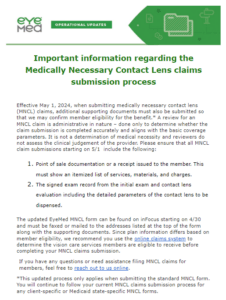
Figure 1
The two major vision plans, EyeMed Vision Care and Vision Service Plan (VSP), recently updated their requirements for medically necessary contact lens qualification. EyeMed covers 72 million members while VSP covers over 85 million members. On May 1, 2024, EyeMed increased documentation requirements for prescribing offices (Figure 1). On June 1, 2024, Vision Service Plan limited necessary contact lens coverage for most medical eye conditions unless eye examination demonstrates that contact lenses improve the eyechart vision by two or more lines over what eyeglasses can provide (Figure 2).
Why is it Harder to get Scleral Lenses Covered?
It comes down to money. Just like how increasing insurance claims are causing homeowner and auto insurance premiums to soar, the same thing is happening in the vision plan arena; increasing claims for necessary contact lenses means that more costs are getting pushed to plan members. Scleral contact lenses and the associated professional services are expensive. The major vision plans are trying to curtail the rising reimbursement claims so that their operations are sustainable.
How Will I Know If My Vision Plan Covers Scleral Lenses?
At the conclusion of your examination, your eye doctor can advise you if you qualify under your vision plan’s necessary contact lens authorization. The criteria for qualification are sometimes complex and can differ from one vision plan to another. Qualification is not for you to determine, but it is based on clinical measurements taken from your eyes which you cannot control. Before proceeding with contact lens prescribing and lens ordering, our patients get an estimate of anticipated out-of-pocket costs prior to custom fabrication of the scleral lenses, so they can decide whether to proceed forth.
What If I Lose Scleral Lens Coverage?
While it is disappointing to lose coverage and you may feel like complaining to a vision plan representative, you should know that most of our patients have found this approach futile. Some have spent hours on the phone or waiting for administrative responses from a customer service representative but to no success as their rules are not negotiable. ReVision Optometry recommends our scleral lens patients to take financial responsibility and direct their own care rather than allowing a vision plan to dictate what is best. Realize that your provider’s office must follow these rules under provider agreement.
The upshot is that scleral lenses and their prescribing services qualify as allowable health spending under flexible spending accounts (FSAs) and health savings accounts (HSAs). FSAs and HSAs saves you money by paying for allowed expenses with pre-tax dollars. The savings can add up if you have access to one of these accounts since scleral lens wearers are to replace their lenses annually.
Legitimate Conditions No Longer Covered
In some cases, patients with a legitimate need for scleral contact lenses will find that their vision plan no longer provides coverage. For example, patients with Sjögren’s Syndrome and exposure keratitis may experience significant eye discomfort without scleral lenses, but without any significant associated decreased vision, both EyeMed and VSP now will not qualify most of these cases.
Monovision May Cause You to Lose Coverage
Monovision is a common strategy to help those over age 40 with age-related loss of reading vision to avoid reading glasses worn with their contact lenses. With monovision, one eye gets good distance vision, and the non-dominant eye gets close-up vision. VSP’s new criteria for necessary contact lens authorization requires contact lens eye chart vision to improve by at least two lines compared with the best eyeglasses. This effectively means that many wearing contact lenses with monovision will instead need distance vision targeted in both eyes to retain necessary contact lens qualification. In a nutshell, if you have qualified in the past for necessary contact lenses due to eye disease and have monovision, expect to now need reading glasses worn on top if you wish to continue qualifying for the necessary contact lens benefit.
ReVision Optometry is a referral-based practice in San Diego providing scleral contact lens services for patients with keratoconus and other complex eye diseases. To schedule an appointment, request your appointment online, or call our office at 619.299.6064.